
Quick answer
What is phonemic awareness? It is a child's ability to hear, pick out and play with the individual sounds inside spoken words, with no letters involved. A child with good phonemic awareness can tell you that "ship" has three sounds, /sh/ /i/ /p/, and that swapping the first sound for /d/ makes "dip".
Phonics comes next, and connects those sounds to letters. That order matters. A child who cannot yet hear the separate sounds in a word has nothing to attach the letters to, so they end up memorising words as shapes, which works for a few hundred words and then collapses.
Little Genius teaching team. We have taught phonics and early reading for nearly 25 years, to 50,000+ students so far, using our Pure Phonics method in one-to-one online classes for families in India and abroad.
Key takeaways
- Phonemic awareness is done with the ears and mouth only. If your child can do it with their eyes closed, it is phonemic awareness; if they need a page, it is phonics.
- The National Reading Panel found that teaching children to work with the sounds in words improved reading and spelling across ages and settings.
- Five to ten minutes a day of oral sound games is enough. Bring letters in early; the research found the two work best together.
Phonemic awareness vs phonics: what is the difference?
The two words sound alike, and they are often used as if they meant the same thing. They do not. The simplest way to hold the difference between phonemic awareness and phonics is this: phonemic awareness happens with your eyes closed; phonics needs a page.
| Phonemic awareness | Phonics | |
|---|---|---|
| What it works with | Spoken sounds only | Sounds and the letters that spell them |
| Needs letters? | No. Can be done in the car or in the dark | Yes. Letters must be in front of the child |
| Example with "ship" | Hearing three sounds: /sh/ /i/ /p/ | Knowing s and h together spell /sh/ |
| What it builds | The ear for sounds | The link from sound to print |
| When it starts | From about age 3, through rhyme and games | Alongside, as soon as sounds are heard clearly |
So phonemic awareness vs phonics is not a choice between two methods. One is the foundation for the other. A child who cannot yet hear three separate sounds in "ship" has nothing to attach the letters s, h, i and p to.
Where does phonological awareness fit in?
You may also hear the term phonological awareness. It is the umbrella. It covers every way of noticing the sound structure of speech, from big chunks down to single sounds. Phonemic awareness is the finest level inside that umbrella, and it is the level that matters most for reading, because the letters in English represent phonemes, not syllables.
| Level | What the child notices | Example |
|---|---|---|
| Words | A sentence is made of separate words | "I like mangoes" has 3 words |
| Syllables | Words break into beats | but-ter-fly has 3 claps |
| Rhyme | Words can share an ending | cat, hat, mat |
| Onset and rime | The first sound splits from the rest | s ... un, s ... ock |
| Phonemes | Every single sound, one by one | /sh/ /i/ /p/ |
English has about 44 phonemes but only 26 letters, which is why many sounds are written with two or more letters, as /sh/ is in "ship". A child who already hears /sh/ as one sound will find it natural that it needs a letter pair. A child who does not will try to sound out /s/ and /h/ separately and get stuck.
What does the research say about phonemic awareness?
The strongest evidence comes from the National Reading Panel, convened in the United States at the request of Congress by the National Institute of Child Health and Human Development. Its 2000 report reviewed the experimental research on how children learn to read. On phonemic awareness, the Panel concluded that teaching children to notice and manipulate the sounds in words was highly effective across a wide range of teaching conditions, learners, and age and grade levels, and that it improved phonemic awareness itself, reading and spelling.
A detailed analysis of the same research was published by Linnea Ehri and colleagues in Reading Research Quarterly in 2001. They reported a moderate, statistically significant effect on reading and on spelling, and found that reading comprehension benefited too, not only reading single words.
What are the five steps of phonemic awareness?
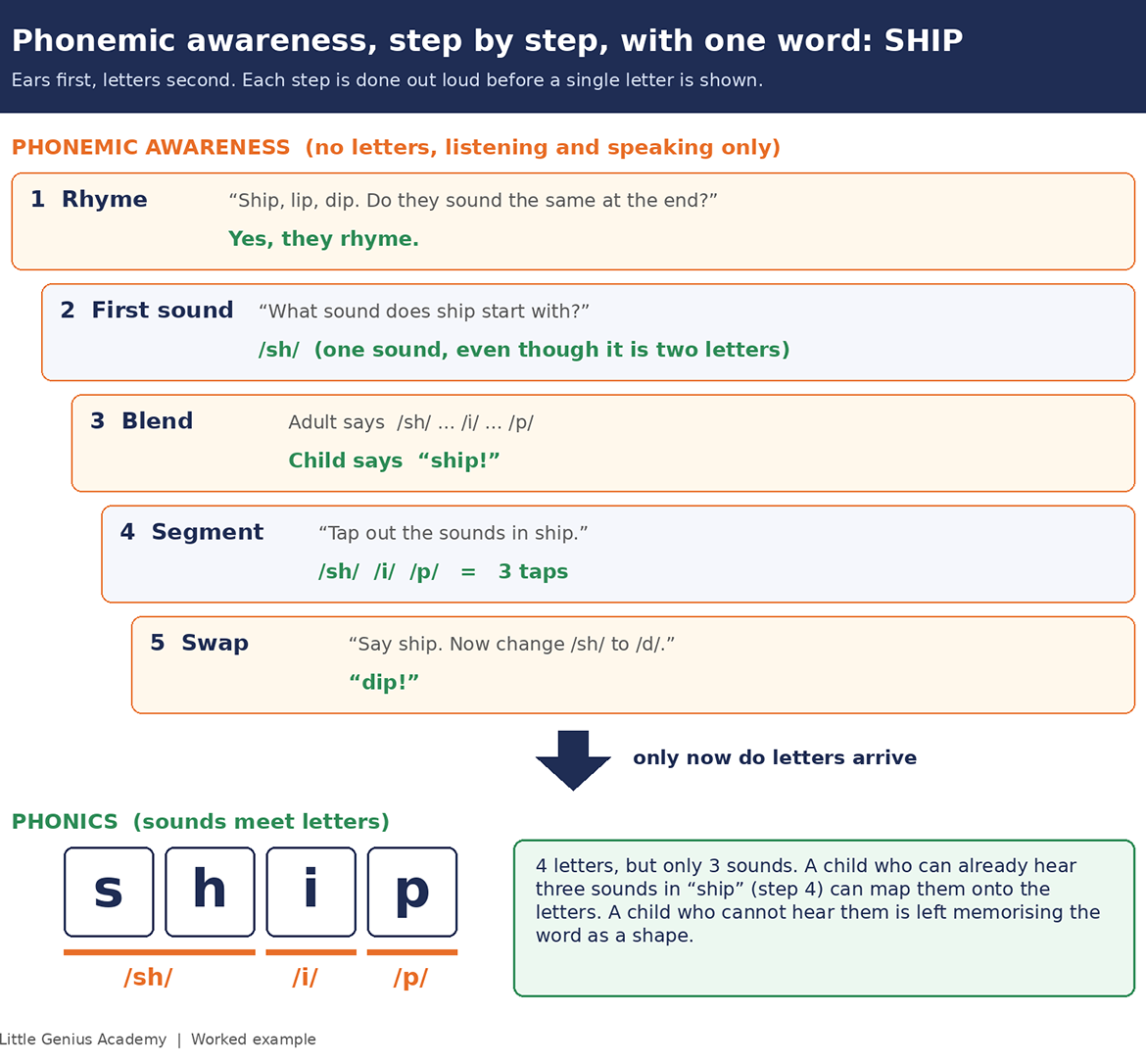
Phonemic awareness builds in a fairly predictable order, from big, easy-to-hear units to single sounds the child can move around. The visual below takes one word, "ship", through all five steps, and then shows the moment the letters arrive.
1. Rhyme
Rhyme asks the child to notice the end of a word without breaking it apart. "Ship, lip, dip: do they sound the same at the end?" It is the gentlest way in, which is why nursery rhymes matter more than they look.
2. First sound
"What sound does ship start with?" This is the first time the child isolates a single phoneme. Listen for /sh/, not "s". Two letters, one sound.
3. Blend
You say /sh/ ... /i/ ... /p/ and your child says "ship". Blending is the skill that powers reading. We explain it in more depth in our guide to blending and segmenting.
4. Segment
The reverse: your child hears "ship" and taps out its three sounds. Segmenting is the skill that powers spelling.
5. Swap
"Say ship. Now change /sh/ to /d/." When a child can swap a sound and make "dip", they really hold each sound separately in their mind. This usually comes last.
8 phonemic awareness activities for kids you can do at home
None of these needs a worksheet, a screen or more than five minutes. Each one has your child saying sounds out loud, which is the whole point.
Sound spy
"I spy something that starts with /m/." Use the sound, not the letter name: say /m/, not "em".
Why it works: trains the ear to isolate the first sound, step 2.
Robot talk
Say a word in separate sounds, /d/ /o/ /g/, and let your child blend it back into "dog". Then swap roles.
Why it works: blending and segmenting in one game.
Tap it out
Your child taps the table once for each sound. "Fish" gets three taps, /f/ /i/ /sh/, not four.
Why it works: makes invisible sounds countable.
Sound swap
"Say mat. Now change /m/ to /s/." Silly words are fine; the skill is the same.
Why it works: manipulation, the highest step.
Rhyme chains
Take turns adding a rhyming word, real or made-up, until someone gets stuck. Pen, ten, hen, zen, blen...
Why it works: builds the first step with no pressure.
Clap the beats
Clap each syllable of family names and foods: ba-na-na, ca-pa-ti... then try single sounds in short words.
Why it works: moves from big chunks to single sounds.
Odd one out
"Sun, sock, map: which one starts with a different sound?"
Why it works: sharpens listening by contrast.
Mirror mouths
Say /p/ and /b/ in front of a mirror and notice the lips. Then /th/ with the tongue peeking out.
Why it works: links each sound to how it feels in the mouth.
Tip: do one activity per session, not all eight. Ten minutes of one game done well beats thirty minutes of rushed variety. Rotate across the week.
Which sounds do Indian children need extra listening practice on?
Children who speak Hindi, Gujarati, Tamil or another Indian language at home sometimes hear two English sounds as one, because their home language does not separate them. This is completely normal and is not a problem with the child. It simply means those pairs need a little extra ear work before the letters arrive.
| English sounds | Often heard as | Listening game |
|---|---|---|
| /v/ and /w/: vet, wet | The same sound | Say pairs and ask "same or different?" Top teeth on lip for /v/, round lips for /w/. |
| /th/: thin | /t/: "tin" | Tongue peeks out between teeth; feel the air on a hand. |
| /th/: this | /d/: "dis" | Same tongue position, add a hum. |
| Final sounds: cap, cab | An extra vowel: "capa" | Clap on the last sound, then stop dead. |
A few minutes of "same or different?" with these pairs makes a real difference later, because a child who hears /v/ and /w/ as different sounds will spell "van" and "wet" correctly without having to memorise them.
Phonemic awareness for kindergarten: what is typical, and when?
Children vary a lot, and the ages below are a rough guide rather than a test.
Rhyme and first sounds
Enjoys rhymes, hears when two words start the same way, and begins to name the first sound of a short word.
Blending and segmenting
Blends and taps out three-sound words like dog, ship and fish. This is why phonemic awareness is such a big focus in kindergarten and Class 1.
Swapping and deleting
Changes or removes a sound to make a new word: ship to dip, slip to lip. Usually the last skill to settle.
If your child is older and still finds blending or tapping out sounds difficult, that is not a reason for worry or for labels. It simply tells you where to start. Phonemic awareness can be taught at any age, and older children often move through the steps quickly once someone works on them directly.

How Little Genius teaches phonemic awareness
Phonemic awareness is the first strand of Reading Circle, our phonics and reading programme for children aged 3.5 to 8, and it is built into the Foundation levels of the English Enrichment Program, which runs from age 3 to 14. Both use our Pure Phonics method.
Each sound is repeated six to eight times before a child is asked to blend it, and each blend is repeated three to five times before it is used in whole words, because a sound heard once is easily lost. Every class is one-to-one and live online, so the teacher hears exactly which sound your child is unsure of and goes back to it straight away.
Frequently asked questions
Is phonemic awareness the same as phonics?
No. Phonemic awareness is hearing and working with the sounds in spoken words, with no letters involved. Phonics is linking those sounds to written letters. The first makes the second much easier, and research shows the two work best when they are taught side by side rather than one after the other.
Should we wait until phonemic awareness is perfect before teaching letters?
No. The National Reading Panel found that sound work was more effective when it was connected to letters. Start with sounds out loud, then bring letters in as soon as your child can hear the sounds clearly, and keep moving between the two.
How much time should we spend on phonemic awareness each day?
Five to ten minutes a day is enough for most children aged 3 to 7. Short, frequent games work better than one long session, and stopping while your child is still enjoying it keeps them asking for more.
Does phonemic awareness help with spelling too?
Yes. Spelling is phonemic awareness run backwards: the child hears a word, splits it into sounds and writes a letter or letter group for each one. A child who can tap out three sounds in "ship" is ready to spell it.
Can older children still work on phonemic awareness?
Yes. Phonemic awareness can be taught at any age. Older children usually move through the steps quickly once someone works on them directly, and the improvement often shows up in spelling within weeks.
Not sure which step your child is on?
A free diagnostic level test shows which of the five steps your child is comfortable with, and where to begin.
Book a free diagnostic level testRelated guides for parents
Sources
- National Institute of Child Health and Human Development: Report of the National Reading Panel, findings and determinations
- NICHD: What is the best way to teach children to read?
- Ehri, L. C. and colleagues (2001). Phonemic awareness instruction helps children learn to read: evidence from the National Reading Panel's meta-analysis. Reading Research Quarterly, 36(3), 250 to 287
- Reading Rockets: Phonemic Awareness Instruction