English fluency isn't one skill: it's five that need to develop together, sounding words out, understanding grammar, holding enough vocabulary to say what you mean, writing it down clearly, and speaking it out loud with confidence. Most tutoring narrows in on just one of these, usually grammar drills, and leaves the rest to chance, which is exactly the gap the English Enrichment Program is built around, covering all five for children aged 3 to 14, taught fully one-to-one, the same approach that has now been used to teach more than 50,000 students.

Thinking in English means a child can form an idea directly in English, without mentally translating from another language first. For example, ask a child what their favourite animal is and why. A child still translating internally has to form the answer in their home language first and then convert it, which is slower and often loses nuance, while a child thinking in English simply answers directly. That directness is what actually shows up as fluency and confidence, not just correct grammar.
Schedule a Free Level Test


| Level | What Your Child Will Learn |
|---|---|
| Foundation ABCs | Introduction to all 26 letter sounds and short vowel sounds, distinguishing frequently confused sounds (a/e, e/i, v/w) and letters (b/d, p/q, n/u), pre-writing strokes and letter formation for upper and lowercase letters, and letter and sound dictation, alongside early spoken English through self-introduction, opposites, situational awareness, and describing actions, objects and people. |
| Foundation: Booster | Systematic consonant-vowel blending built up family by family across all five short vowel sounds (a, e, i, o, u), reading, matching and spelling practice for each word family, Dolch sight word practice, CK-ending words, the FLOSZ double-letter spelling rule, distinguishing vowels from consonants, articles (a/an), and early sentence formation, with communication skills and comprehension built in throughout. |
| Foundation Building: Basic | Letter names, sounds and actions A to Z, Pure Phonics foundations, pre-writing and fine-motor skills, systematic consonant-vowel blending through short-vowel word families, early sight words, beginning communication skills (greetings, answering simple questions), building up to simple sentence formation and early comprehension. |
| Foundation Building: Advanced | More advanced Pure Phonics patterns (vowel digraphs and blends, soft consonant sounds, common word endings), continued sight-word practice, phonemic awareness, foundational grammar (this/that/these/those, prepositions, opposites, action words, was/were, has/have), and simple comprehension passages, with spoken English throughout. |
| Level 1 | Syllables and articles (a/an/the), nouns, plurals, pronouns, adjectives, opposites, is/are/am, action words, prepositions, basic punctuation, simple comprehension and picture composition, with spoken English practice in every session. |
| Level 2 | Articles in more detail, common/proper/collective nouns, plural rules, gender, pronoun types, present tense, an introduction to degrees of comparison, punctuation, and letter writing (for example, birthday invitations). |
| Level 3 | Abstract nouns, idioms, the four sentence types, countable and uncountable nouns, synonyms, formal and informal letters, degrees of adjectives, subject and predicate, diary entries, an introduction to tenses, and autobiography writing. |
| Level 4 | Capitalisation, similes, pronoun types (personal, possessive, demonstrative, interrogative, reflexive), interrogative and negative sentences, present/past/future tenses and their continuous forms, verb forms, homophones, and story writing. |
| Level 5 | All eight parts of speech, question tags, direct and indirect objects, transitive and intransitive verbs, determiners, the full pronoun system, prefixes and suffixes, the complete tense system including perfect continuous, non-finite verbs (gerunds, infinitives), essay writing and debate skills. |
| Level 6 | Non-finite verbs in depth (gerunds, infinitives, participles), auxiliary verbs, sentence transformation (active to passive, direct to indirect speech, affirmative to negative), phrases and clauses, figures of speech, all conjunction types, and formal writing (email, report, notice, message, dialogue, blog, article). |


A child's level in the English Enrichment Program is set by what they can actually do, not by which grade they're in at school. If the pace is too easy, a child gets bored and disengages. If it's too challenging, they give up before they've really tried. Neither helps them learn, which is why some children who are in a higher grade at school sit at an earlier level here.
That isn't a step backward: it's making sure the foundation underneath, like phonics and sentence structure, is genuinely solid before building further on it. One-to-one teaching is what makes this possible, since a tutor can adjust the pace for one child in a way a classroom of 30 simply can't.
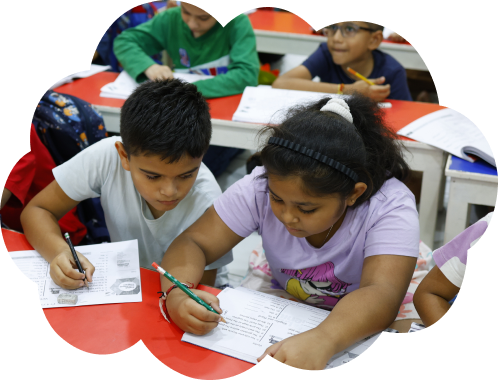




English is the language of school, higher education, and most workplaces, including for subjects like maths and science, where a child who's still mentally translating loses time and confidence before they even get to the content. The practical skill isn't reciting grammar rules. It's thinking in English fluidly enough that expression, not translation, is the bottleneck. That's the specific gap the English Enrichment Program is built to close, through consistent speaking practice rather than grammar memorization alone.
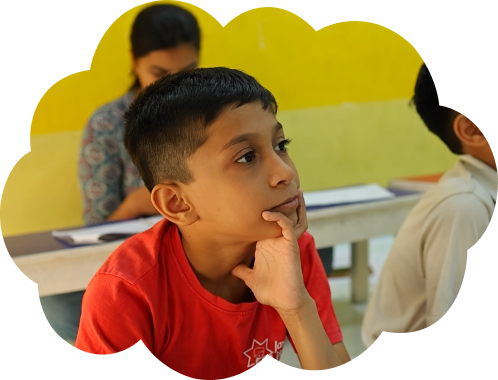
This is one of the most common things parents notice, and it isn't a sign of carelessness. Spoken grammar allows real-time self-correction, since a child can restart a sentence mid-way if it sounds wrong, while writing requires holding the entire grammatical structure in mind before committing it to the page, with no live feedback loop to catch a slip. The English Enrichment Program addresses this directly by pairing spoken practice with structured writing exercises in the same sessions, rather than treating speaking and writing as separate skills taught at separate times.
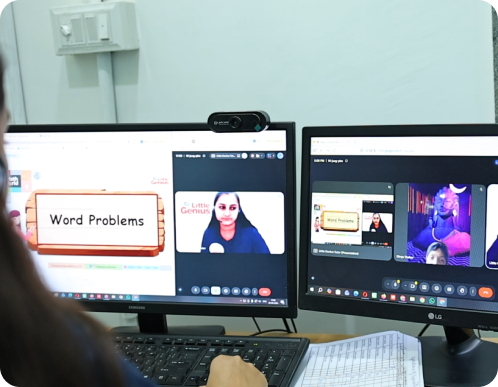




The English Enrichment Program is designed to reinforce your child's actual school curriculum rather than run a parallel one. In India, that means it supports the English requirements of CBSE, ICSE, IGCSE, the IB, and every major state board. For families abroad, the same five-area approach (phonics, grammar, vocabulary, creative writing, and public speaking) reinforces English taught under the UK National Curriculum, the US Common Core and state standards, the Australian Curriculum, Gulf and Middle East school systems, and the Singapore MOE syllabus, because reading, grammar, vocabulary and spoken confidence are foundational skills every one of these systems ultimately requires, even where the exact syllabus sequencing differs.
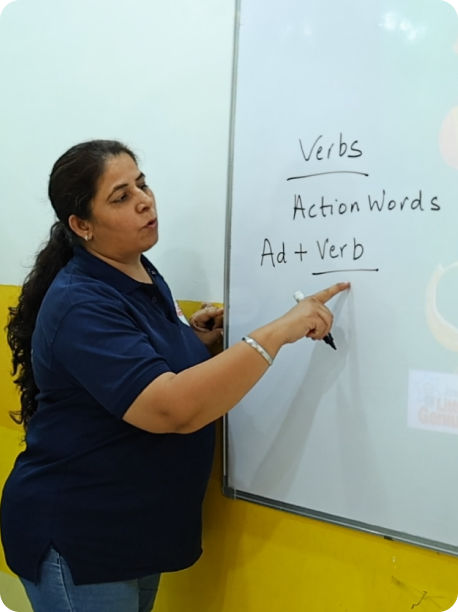
Many of the families in this program are raising Indian-heritage children outside India, where English may be the language of school but not always the language spoken at home in the same way. That's a genuinely different starting point than a child raised with English as the sole home language, and it's factored directly into how phonics, vocabulary and speaking practice are paced here, treated as a normal starting point rather than a special case. Sessions are scheduled around your family's time zone, whether that's Vadodara, Dubai, London, or Toronto.


Children aged 3 to 14. As with all Little Genius programs, a free diagnostic level test finds your child's real starting point rather than placing them by age or school grade alone.
Five connected areas taught together, not in isolation: Phonics (using Pure Phonics), Grammar, Vocabulary Development, Creative Writing, and Public Speaking and Communication Skills. Olympiad Training is also built into the same curriculum for children who want to test their skills competitively. The program is built around a seven-part method (Read, Write, Listen, Speak, Connect, Evaluate, See) so these skills reinforce each other in every session rather than being drilled separately.
A grammar tutor typically focuses on rules and correction. This program builds grammar alongside vocabulary, writing and speaking in the same sessions, because a child who can recite a grammar rule but freezes when asked to actually speak or write hasn't yet built communication, only rule recall.
This is common and not a sign your child isn't trying. Spoken English allows real-time self-correction that writing doesn't: writing requires holding the full sentence structure in mind before committing it to the page. Sessions are structured to pair spoken and written practice together so that gap closes over time.
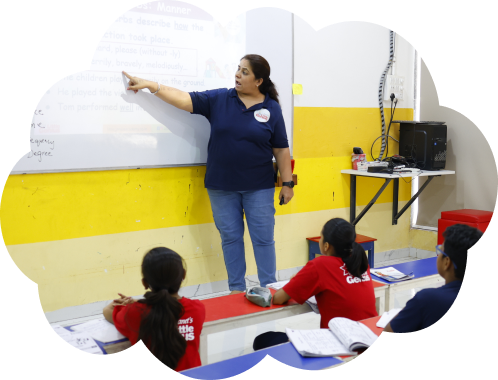
The English Enrichment Program is taught fully one-to-one. Your child has the tutor's complete attention for every session, which is what lets sessions focus on the specific areas, like public speaking confidence or writing structure, that matter most for your child.
Yes, classes run live online with scheduling built around your family's time zone. A significant share of families in this program are based outside India.
Yes. This is the difference between receptive and expressive vocabulary: recognizing a word is a different skill from actively using it in speech or writing. The Connect and Speak components of each session are specifically built to close that gap through repeated, realistic use rather than passive exposure.
It's designed to work alongside your child's school curriculum, reinforcing the same core skills (reading, writing, speaking, grammar) with the individual attention a classroom of 30+ students can't always provide, rather than replacing what's taught at school.
It's a common worry, and in a one-to-one setting it's usually the opposite. Speaking in front of a group can worsen shyness because the audience itself is the source of the anxiety; removing that audience while still practicing the skill lets confidence build privately first, before it's tested in front of others.
Corrections happen in the moment during guided practice, not after the fact on a graded page. Keeping feedback attached to the specific attempt, rather than a verdict delivered on the finished piece, is what protects a child's motivation to keep writing, rather than making them dread the next assignment.
Very common, especially in bilingual or multilingual homes, and it isn't a sign of weaker overall language ability: vocabulary in each language is built through separate exposure and practice. The Connect and See components of each session are specifically about building English vocabulary through repeated real use, independent of how strong a child's vocabulary already is in another language.
Yes. Phonics is one of the five core areas the English Enrichment Program builds from Foundation level, using the same Pure Phonics method as Reading Circle. Reading Circle is a separate, more intensive program for children already at school who need focused, dedicated work on reading specifically; the English Enrichment Program teaches phonics as one part of a broader communication curriculum for children starting from an earlier age.
This is very common in bilingual and multilingual households and isn't a sign of confusion. It's a normal part of how children build two languages at once. The program's focus on speaking and thinking directly in English, rather than translating, is specifically what reduces this kind of mid-sentence switching over time, without asking a child to set their home language aside.
It does. Foundation ABCs sessions run 45 minutes each, 20 sessions in total. Foundation: Booster sessions run 50 minutes each, 60 sessions in total across two 30-session terms. From Foundation Building: Basic through Level 6, sessions run 60 minutes each, 72 sessions per level across two 36-session terms.