
Most children can eventually get to the right answer, but far fewer can explain how they got there, apply the same idea to an unfamiliar kind of problem, or still remember it months after the exam, and that specific gap is what Math World is built to close. It's a live, one-to-one online maths program for children aged 3 to 14, where a dedicated tutor works toward genuine concept mastery rather than repetition, the same approach that has now been used to teach more than 50,000 students.


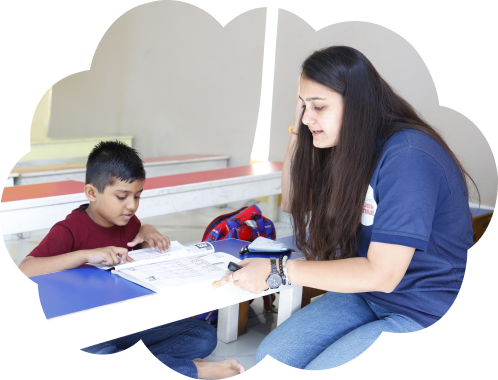
Concept-based learning means a child understands why a method works, not just the steps to follow. For example, a child taught that 3 × 4 means "3 groups of 4" can still work out the answer even if they forget the fact, by picturing three groups of four and counting them. A child who's only memorized "3 × 4 = 12" has nothing to fall back on if that fact slips their mind. Math World is built around teaching the first way, not the second.
Schedule a Free Level Test


| Level | What Your Child Will Learn |
|---|---|
| Foundation Building: Basic | Numbers 1 to 10, counting and number formation, basic shapes, size comparisons (big/small, full/empty), and one-to-one correspondence, with seasons and body parts woven in as early general knowledge. |
| Foundation Building: Advanced | Numbers up to 30, before/after/between, ascending and descending order, and shapes and colour recognition, with plants, animals and everyday objects as general knowledge themes. |
| Level 1 | Numbers up to 100, addition with and without carrying, number lines and the abacus, and multiplication tables 1 to 4, alongside a dinosaurs-and-space general knowledge theme woven throughout. |
| Level 2 | 3-digit numbers, place value and expanded form, odd and even numbers, ordinal numbers, and multiplication tables 5 to 8, continuing the dinosaurs-and-space general knowledge theme. |
| Level 3 | 4-digit numbers, place value, rounding off, an introduction to multiplication and division, tables up to 15, and Roman numerals, alongside the year's richest general knowledge strand: the animal kingdom, Earth and the solar system, the seven continents, oceans and rivers, landforms, and the wonders of the world. |
| Level 4 | Large numbers (5 to 6 digit, lakhs), all four operations, geometry basics (shapes, angles, polygons, circles), factors, multiples, HCF/LCM, an introduction to fractions and algebra, and length and weight conversions. This is also where dedicated logical reasoning practice begins, including seating arrangements, blood relations, pattern and input-output puzzles, and brain-teaser problems. |
| Level 5 | Numbers up to 9 digits (Indian and International systems), Roman numerals, addition and subtraction of large numbers, profit and loss, and multiplication and division with larger numbers, alongside continued logical reasoning practice: analogies, embedded figures, and blood relations problems. |
| Level 6 | Very large numbers (up to crores/billions, Indian and International systems), VBODMAS, rounding and estimation, factors, multiples and divisibility rules, and word problems, alongside continued logical and analytical reasoning practice at a more advanced level. |


A child's level in Math World is set by what they actually understand, not by which grade they're in at school. If the pace is too easy, a child gets bored and disengages. If it's too challenging, they give up before they've really tried. Neither helps them learn, which is why some children who are in a higher grade at school sit at an earlier Math World level. That isn't a step backward: it's making sure the foundation underneath is genuinely solid before building further on it. One-to-one teaching is what makes this possible, since a tutor can adjust the pace for one child in a way a classroom of 30 simply can't.


A child who memorizes that 7 × 8 = 56 has stored one fact. A child who understands multiplication as repeated addition, can picture it as an array, and can reconstruct the fact if they forget it has built a tool they can reuse everywhere: word problems, fractions, and algebra later on. That's the actual, practical difference between rote and concept-based learning. It's also the single biggest reason children who "know their tables" still calculate slowly or freeze on word problems: the underlying number sense was never built, only the surface fact sitting on top of it.
Math World is structured so a child only advances once a concept is genuinely internalized. This is verified through the diagnostic level test at the start and through continuous in-class assessment throughout, not simply once a worksheet is completed.
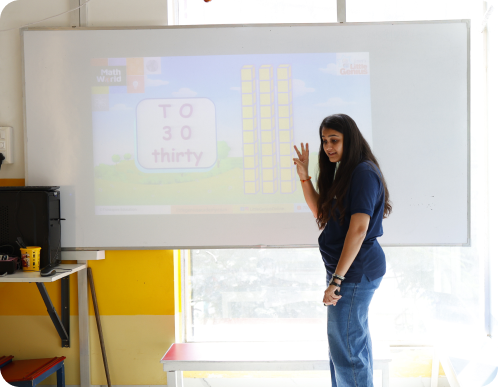






Math World is designed as a supplement to your child's school maths, not a parallel or competing syllabus. In India, that means it's built to reinforce what's taught under CBSE, ICSE, IGCSE, the IB, and every major state board. For families abroad, the same concept-based approach reinforces maths taught under the UK National Curriculum, the US Common Core and state standards, the Australian Curriculum, Gulf and Middle East school systems, and the Singapore MOE syllabus, since the underlying mathematical concepts, number sense, place value, fractions, and problem-solving are universal even when the exact syllabus sequencing differs by country.
This is precisely why Math World is placed by a diagnostic level test rather than a school grade: a child following the UK National Curriculum in Year 4 and a child following CBSE in Grade 4 may be at genuinely different points in the same underlying concepts, and the level test finds where each child actually is rather than assuming their school grade abroad maps neatly onto an Indian one. Sessions are then scheduled around your family's time zone, which matters as much for a family in Vadodara juggling school timings as it does for a family in Sydney, Toronto, Dubai, or London.
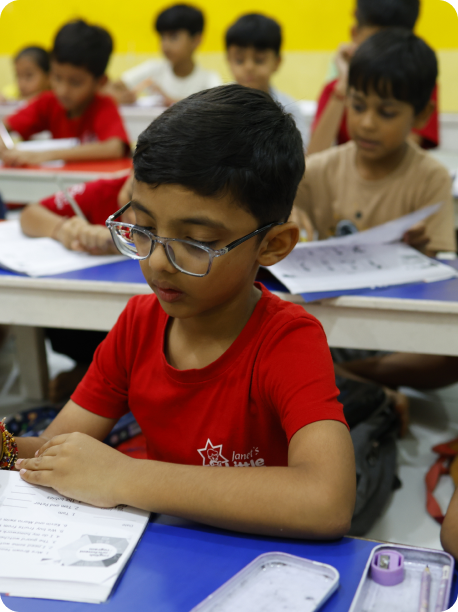

Several well-known maths platforms for kids are built around self-paced app modules with periodic teacher check-ins. Math World is the opposite structure by design: every session is live and one-to-one, with a real tutor watching your child work in real time. That's a slower model to scale, but it's exactly why it catches the specific place a child gets stuck, such as a missed step in "showing the method" rather than just a wrong final answer, instead of only reporting a completion percentage.
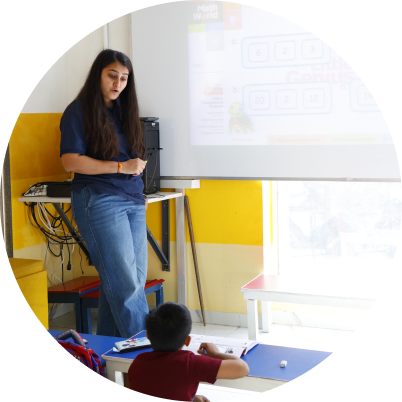
Children aged 3 to 14. Starting level isn't based on age or school grade alone: every child begins with a free diagnostic level test, and the program is paced from wherever they actually are, not where their age or grade assumes they should be.
Yes, this is one of the most common gaps Math World is built to close. Schools increasingly assess the reasoning process, not just the answer, because it's the clearest signal of real understanding. Sessions are structured so a child explains their thinking out loud as they work, which is exactly the habit that later shows up as marks for method, not just the final number.
Math World is taught fully one-to-one. Your child has the tutor's complete attention for every session, which is what allows the pace to adjust in real time to how your child is actually learning, not a fixed group pace.
It's built to reinforce your child's actual school curriculum, whether that's CBSE, ICSE, IGCSE, IB, state board, or an international curriculum abroad, rather than run a parallel one. The goal is that what's taught here shows up as visible improvement in school work, not just in isolated online sessions.
Yes, Math World is taught live online to children in India and abroad, including NRI families across time zones. Scheduling is built around your family's actual day, not a fixed India-time slot.
App-based programs are typically self-paced with periodic teacher check-ins; Math World is the reverse: every session is live and one-to-one with a tutor present the entire time. That live presence is what catches a specific stuck point in a child's method, not just a completion score.
All three are common, and the response is the same in each case: the diagnostic level test places your child at the level that's genuinely right for them, not their school grade. A child who's ahead moves into more challenging or Olympiad-level material sooner; a child who needs more foundational work gets that, without being rushed to keep pace with a grade label that doesn't reflect where they actually are.
Most parents notice a shift in confidence and speed within the first 8 to 10 sessions: a child attempting word problems instead of avoiding them, or working through steps instead of guessing. Deeper conceptual gains, like consistently retaining a concept past the next test, tend to show over 2 to 3 months of consistent sessions.
Often, yes, because the anxiety is usually less about maths ability and more about repeated experiences of not keeping up in a group setting. A one-to-one format removes the two biggest triggers for that anxiety: visible comparison with faster classmates and making mistakes in public. Most children visibly relax within the first few sessions, before their actual maths skills have even had time to improve.
Concept mastery is assessed every session, not just at conference time: a child doesn't move on to the next concept until the current one is solid. The parent-teacher conferences are where that ongoing tracking gets shared with you formally; they aren't the only point at which progress is actually being measured.
Usually neither, in the way it looks. Rushing is often a symptom of low confidence: a child races to finish before they can be seen struggling, and that's when careless errors happen. Building genuine concept confidence, rather than pushing for speed, is usually what actually reduces careless mistakes, which is why Math World prioritizes understanding over pace.
Your child is paired with a dedicated tutor for the program, so there's continuity session to session rather than a different face each time, which matters for a tutor to actually notice a specific, recurring stuck point. Tutors are trained specifically in Math World's concept-based teaching approach, not just subject-matter knowledge.
General knowledge is woven directly into maths sessions from Foundation Building through Level 3, covering topics like the solar system, the animal kingdom, continents, oceans and the wonders of the world. From Level 4 onward, the maths syllabus itself expands considerably, geometry, fractions, algebra, large numbers and eventually percentages and profit-and-loss all enter the picture, so sessions shift focus to dedicated logical reasoning and critical-thinking practice instead: seating arrangements, blood relations, analogies and brain-teaser problems. This is a deliberate choice, not an oversight; those reasoning skills are what actually shows up in competitive exams and Olympiad-style assessments later on.
Sessions at Foundation Building: Basic and Foundation Building: Advanced run 45 minutes. From Level 1 through Level 6, one-to-one sessions run 60 minutes, which is the length that best matches how long children at that stage can hold sustained focus.