




Online Math Classes for Kids in Canada: Concept-First Maths for Indian Families, Grade 1 to Grade 6
If you are searching for online math classes for kids in Canada, you are probably weighing two things at once: how your child is actually doing in maths at school here, and whether the maths you grew up with in India still has something to offer. Both questions deserve a real answer. In this guide we look at what Canada's own assessment data says about primary maths, what the Ontario curriculum now expects children to know by heart, and what a good one-to-one online class should do about it, with one worked example you can try at home tonight.
How are children in Canada doing in maths?
The honest answer is: reasonably well by international standards, but with a clear and steady slide, and with a large share of children not yet secure in the basics. In the OECD's PISA 2022 assessment, Canadian 15-year-olds scored 497 in mathematics against an OECD average of 472, according to the Council of Ministers of Education, Canada. That is still above average. But the same CMEC summary shows Canada's maths score falling from 532 in 2003 and 518 in 2012, and only about four in five students reached the baseline proficiency level.
The primary-school picture is sharper. Ontario tests every child in Grade 3 and Grade 6 through the Education Quality and Accountability Office (EQAO). In the 2024 to 2025 results, 64 per cent of Grade 3 students in English-language schools met the provincial standard in mathematics, and only 51 per cent of Grade 6 students did. Put the other way round, roughly one Grade 6 child in two in Ontario's English-language schools is not yet meeting the expected standard in maths. That is the context in which so many families start looking for math tutoring for kids in Ontario and across the country.
Numbers like these are not a verdict on any one child. They tell us that gaps in primary maths are common, that they tend to widen between Grade 3 and Grade 6, and that waiting for school alone to close them is a gamble. The earlier an idea is understood properly, the less there is to repair later.
What does the Ontario curriculum expect children to know by heart?
Ontario introduced a new elementary mathematics curriculum in 2020, organised into six strands: number, algebra, data, spatial sense, financial literacy, and social-emotional learning skills with mathematical processes. It added coding from Grade 1 and financial literacy from Grade 1, when children start recognising Canadian coins and bills. Other provinces have their own curricula, but the direction of travel across Canada is similar.
One part of the Ontario document will feel familiar to Indian parents: it expects children to recall multiplication facts. The Ministry's own summary sets out the progression. In Grade 3, children learn the 2, 5 and 10 times tables; in Grade 4, multiplication facts up to 10 times 10; and from Grade 5 onward, facts up to 12 times 12, along with the related division facts and mental maths strategies. In other words, the expectation that children know their tables has not gone away in Canada. What many parents notice is that classroom time to make those facts automatic is limited, so the facts are introduced but not always secured.
Why do maths facts slip, even when a child seems to understand them?
There are two common ways a times-table fact goes wrong, and they need opposite fixes. In the first, a child has memorised a chant without the idea underneath it. Ask them 7 times 6 instead of 6 times 7, or 6 times 70, and the chant does not help. In the second, a child understands the idea perfectly well but has never practised enough for the fact to become instant. They work out 6 times 7 every single time by counting in sixes, which is slow, tiring and error-prone in the middle of a longer question.
Our approach at Little Genius is to do both halves in order. First the child understands the fact, using a picture and a fact they already know. Then the fact is memorised on purpose, because instant recall frees the child's attention for the actual problem. Deriving a table mid-question adds a step and slows a child down. Understanding first and memorising second is what makes the memory stick.
A worked example: 6 times 7, from a picture to instant recall
Here is how this looks with a Grade 4 child in one of our online maths classes in Canada. The tutor starts with an array on the shared whiteboard: 6 rows of 7 counters. The child counts the rows and says what the picture means in their own words, six equal groups of seven. Then the tutor draws a line under the fifth row. The child already knows 5 times 7 is 35, because the 5 times table was secure from Grade 3. The last row is 1 times 7, which is 7. So 6 times 7 is 35 plus 7, which is 42.
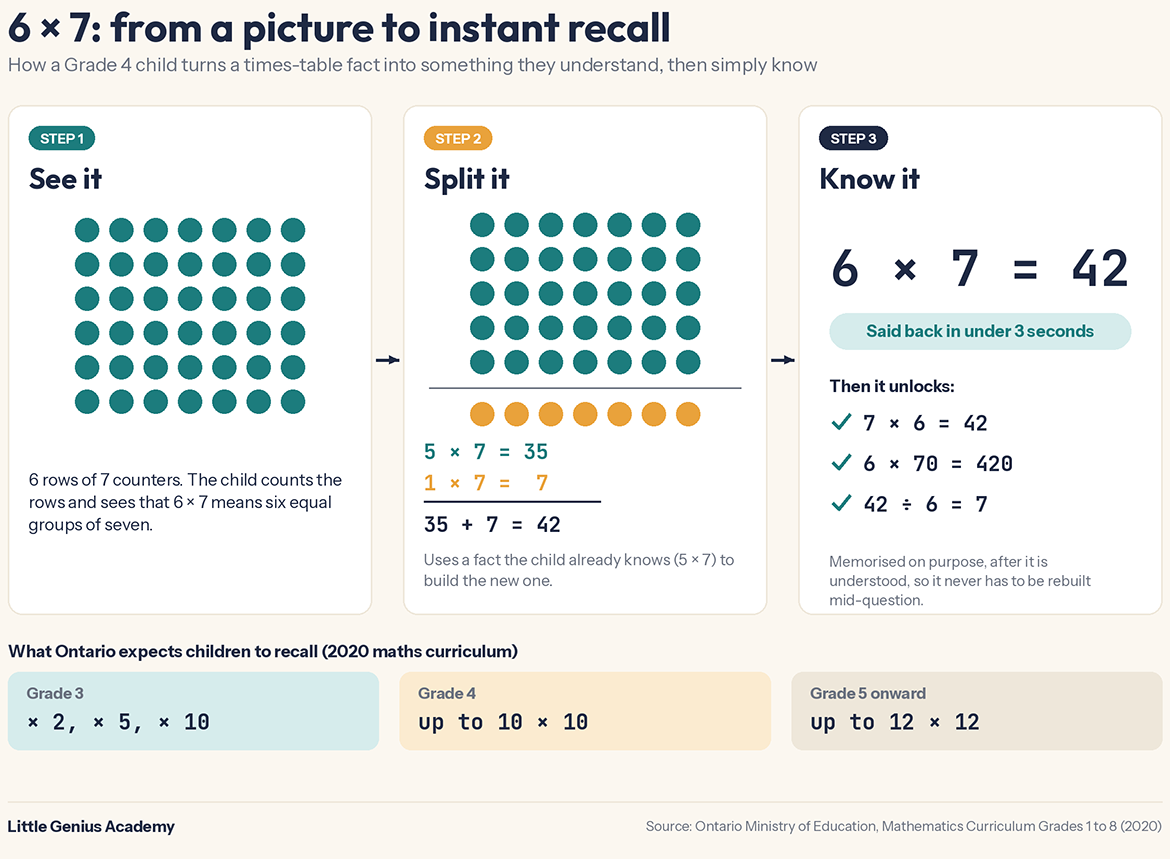
Worked example: a Grade 4 child sees 6 × 7 as an array, splits it into 5 × 7 = 35 and 1 × 7 = 7 to reach 42, then practises until 6 × 7 = 42 comes back instantly and unlocks 7 × 6, 6 × 70 and 42 ÷ 6. Bottom: Ontario's recall expectations by grade.
Only now does practice begin. The tutor asks for 6 times 7 several times across the session, mixed in with other facts, until the child says 42 in under three seconds without counting. The next session opens with it again. Within a week the fact is not something the child works out; it is something they know. And because they understood it first, the same fact quietly answers 7 times 6, 6 times 70 and 42 divided by 6. One fact, understood and then memorised, unlocks four.
You can try this at home with any fact your child finds slippery. Build it from a fact they already know, say it aloud together, then come back to it the next day and the day after. Short, frequent recall beats one long session.
Why do Indian families in Canada look for a one-on-one math tutor?
When we speak with parents who are looking for math classes for Indian kids in Canada, three reasons come up again and again.
- They want depth on the basics. Many parents remember learning tables, place value and mental maths thoroughly, and they want their child to have that same fluency alongside the problem-solving and reasoning Canadian classrooms do well.
- They want the teaching to adapt to their child. In a class of twenty-five, a teacher cannot stop for one child's particular misunderstanding. A one-on-one math tutor in Canada can, minute by minute.
- They may move again. Families who might relocate to India, the Gulf or another country want maths that travels, built on ideas rather than on one textbook's method.
The research supports the one-to-one format. The Education Endowment Foundation in England, which reviews evidence for schools, rates one-to-one tuition as having a high impact for moderate cost, with an average gain of about five additional months' progress over a year. The gains are largest when sessions are regular, short and linked to what the child is learning.
How is a one-on-one math tutor in Canada different from a regular homework tutor?
Many families start with a local tutor who helps with homework, and that can be useful. But helping with this week's homework and building a child's maths from the ground up are different jobs. Here is how a typical homework tutor compares with the way Math World is taught. Whichever you choose, these are fair questions to ask any tutor.
| A typical homework tutor | Little Genius Math World | |
|---|---|---|
| What the session follows | This week's school worksheet or test | A structured curriculum, level by level, that usually runs ahead of school |
| Where it starts | The current school chapter | A free diagnostic level test that finds the exact idea your child is missing |
| When a mistake repeats | The right answer is shown again | The tutor asks the child to explain, finds the rule causing it, and rebuilds the idea |
| Times tables and number facts | Practised if homework needs them | Understood first, then memorised on purpose until recall is instant |
| Reasoning and Olympiad | Not usually part of homework help | Analytical reasoning in every level, with 7 to 9 weeks of Olympiad training built in |
| Continuity | Depends on the tutor's availability | The same trained tutor every session, plus a relationship manager for parents |
| Progress | Judged by the next school test | Tracked against each level's syllabus, so you can see which ideas are secure |
The difference that matters most is the one in the third row. A homework tutor fixes this week's answers; a structured programme fixes the idea underneath them, so the same mistake stops coming back next month.
What do our online maths classes in Canada actually cover?
Math World is our concept-based mathematics programme for children aged 3 to 14, from the Foundation levels through Level 6. It covers four connected areas:
- Mathematics: number, place value, the four operations, fractions, decimals, geometry, measurement and, at the upper levels, algebra, percentages, ratio and profit and loss.
- Numeracy: number sense and mental maths, including memorised tables, so a child can estimate a grocery bill or a distance as easily as they finish a worksheet.
- Analytical reasoning: patterns, puzzles and multi-step word problems. Olympiad preparation is built into the programme, with 7 to 9 weeks of focused training inside Math World rather than as a separate course.
- General knowledge: real-world themes woven into maths sessions up to Level 3, which then give way to dedicated logical reasoning from Level 4.
From Foundation Basics through Level 6, each level runs as 72 sessions across two terms of 36. Sessions are 45 minutes at the Foundation levels and 60 minutes from Level 1. Every parent also has a dedicated relationship manager for questions along the way.
Math World is not a copy of any one provincial curriculum, and we do not claim it matches Ontario, British Columbia or Alberta topic for topic. It builds the underlying skills that every system relies on, and it usually runs ahead of school, so by the time a topic arrives in your child's Canadian classroom, the idea is already familiar. Families also come to us from CBSE, ICSE, IGCSE and IB backgrounds, so if you expect to move between systems, the core ideas stay the same.
How do online classes work for families in Canada?
Every class is one tutor and one child, live online, on a laptop or tablet with a shared digital whiteboard. Your child writes on the board, drags counters, and explains their thinking aloud; the tutor sees every step of the working, not just the final answer. The same tutor teaches your child every session, so they quickly learn where your child hesitates and which explanations land.
Because our teaching team is based in India, the class times that usually line up for families in Canada are early mornings before school and weekends, and families on the Pacific coast can often use an early-evening slot as well. Your relationship manager helps you find a regular time that suits your child's energy, not just the calendar.
Over nearly 25 years, our team has taught 50,000+ students so far. That experience shows most clearly in diagnosis: we have seen most of the ways a maths idea can go wrong, and we know how to find the one that applies to your child. You can see the full level-by-level syllabus on our one-on-one online maths classes page.
Frequently asked questions
Are online math classes for kids in Canada as effective as in-person tutoring?
For maths, often more so. The shared whiteboard keeps every step visible, the tutor can
return to an earlier example instantly, and there is no travel time to eat into a school
evening. What matters most is that the class is one-to-one, regular and with the same tutor.
Will an online math tutor for NRI kids in Canada follow my child's school curriculum?
We teach the ideas behind the curriculum rather than the exact sequence of one province's
textbook. Because Math World usually runs ahead of school, homework and tests tend to become
revision rather than first exposure. If a particular school topic is causing trouble, the tutor
can address it within the session.
My child is in Grade 4 but finds maths hard. Will they start at Grade 4 level?
Not
necessarily. Every child starts with a free diagnostic level test, and placement follows what
your child actually understands, not their school grade. A child may start at an earlier level
so that the foundation is secure, and then move faster once it is. Too easy and a child gets
bored; too hard and they give up.
Do you still make children memorise tables?
Yes, on purpose, after the idea is
understood. Ontario's own curriculum expects recall of multiplication facts up to 12 times 12
from Grade 5. Instant recall keeps working memory free for the actual problem, which is why we
treat it as essential rather than old-fashioned.
What age is Math World for?
Math World is for children aged 3 to 14, from the
Foundation levels through Level 6. Younger children start with number sense, counting and early
shapes; older children work through fractions, decimals, algebra and reasoning.
Book a free diagnostic level test
If you are looking for online math classes for kids in Canada that build real understanding and then make it stick, start with a free diagnostic level test. It shows exactly which ideas your child has secured and which ones need work, so the very first class is spent on the right thing.
Related Posts

Teach Your Child to Make Rational Decisions
Read More


Importance of Communication
Read More
Teamwork for The Win?
Read More
Time Management
Read More
English At Home
Read More
Sustainable Leaders of The Coming Decade / Agents of Change
Read More
Importance of Developing Soft Skills
Read More
How to Make a Bumpy Transition Seamless
Read More
How to prepare for your child?s career
Read More
Sustainable Materialism
Read More
Benefits of Volunteering from An Early Age
Read More
Dynamic of a teacher and students in a modern-day classroom setting
Read More
The usefulness of art methods in reducing daily life stress for children?
Read More
Online safety for kids
Read More
Tips to make a child a better speaker/reader
Read More
How to Be a Working Parent
Read More
Raising Easily Distracted Children
Read More
Talking about puberty with children
Read More
Tips for Raising Kids in Multigenerational Households
Read More
Importance Of Logical Reasoning In The 21st Century
Read More
A Complete Guide To Developing Soft Skills
Read More
How to teach public speaking to your children
Read More
How do I make my child a better speaker
Read More
Importance of Skill Based Learning
Read More
Importance of Parents? Involvement in Early Childhood Education?
Read More
Strategies for tackling homework with kids
Read More
Kinesthetic Multiplication Activities for Kids
Read More
Outdoor Learning: Engaging energetic kids
Read More
Engaging Creative Writing Exercises for Young Minds
Read More
Top 10 Ways to Solve Comprehension Questions
Read More
How to Prepare for Spelling Bees
Read More
How to Develop Strong Comprehension Skills in Kids
Read More
The Discipline Flowchart for Kids
Read More
The Future of Learning: How AI is Transforming Education for Kids
Read More
Empowering Financial Minds Early?
Read More
Why Spelling Bees are Important for Your Child's Future
Read More
Mastering Basic Math Facts
Read More
Phonics That Work: Helping Your Child Read Confidently in 90 Days
Read More
Grammar Without Tears: How to Build English Fluency in Young Children
Read More
Creative Writing for Kids: Igniting the Spark of Imagination
Read More
How One-on-One English Classes Online Are Transforming Learning for Kids
Read More
Cracking the Code: How Strong Numeracy Skills Shape Future Success in Math and Beyond
Read More
Why Grammar Still Matters in the Age of Texts and Emojis
Read More
Building Confidence Through Public Speaking: The Little Genius Approach
Read More
Unlocking Confidence Through Communication: Why Public Speaking Should Start Young
Read More
5 Ways to Integrate Geography in Children's Learning Journey
Read More
Mastering Grammar: The Key to Confident Communication for Young Learners
Read More
Early Math Skills in Indore: Giving 3-Year-Olds a Head Start with Numbers
Read More
Early Math Learning in Udaipur: Helping 3-Year-Olds Build Confidence with Numbers
Read More
Building Early Reading Skills in Indore: Why Phonics Is the Key for 3-Year-Olds
Read More
Teaching Your Child to Work as a Team
Read More
Why Pure Phonics Works Better Than Synthetic Phonics for Indian Learners ? A Parent?s Guide from Jaipur
Read More
Best Phonics Class in Jodhpur: How Pure Phonics Builds Confident Readers
Read More
Best Phonics Class in Udaipur: Helping Children Read with Clarity and Confidence
Read More
Best Phonics Class in Kanpur: Helping Children Read with Confidence Through Pure Phonics Learning
Read More
Best Phonics Class in Patna: Helping Children Read with Clarity and Confidence Through Pure Phonics
Read More
Best Phonics Class in Jamnagar: Building Confident Readers Through Pure Phonics
Read More
Best Phonics Class in Hebbal: Building Strong Reading and Speaking Skills Through Pure Phonics
Read More
Best Phonics Class in Malleshwaram: Helping Children Build Strong Reading Skills Through Pure Phonics
Read More
Best Phonics Class in Electronic City: Helping Children Become Clear, Confident Readers Through Pure Phonics
Read More
Why Online Phonics Classes Are the Best Start for Early Readers (Ages 4–6)
Read More
How Online Phonics Classes Build Strong Reading and Speaking Skills in Children
Read More
Why Online Phonics Classes Are the Best Start for Early Readers (Ages 4–6)
Read More
Pure Phonics vs Memorisation: How Children Learn to Read Independently
Read More
Best Phonics Class in Raipur: Building Strong Readers Through Pure Phonics Teaching
Read More
Blending and Segmenting: The Skills That Turn Sounds Into Reading
Read More
Blending and Segmenting: The Skills That Turn Sounds Into Reading
Read More
Blending and Segmenting: The Skills That Turn Sounds Into Reading
Read More
Best Phonics Class in Nagpur: Helping Children Read with Confidence Through Pure Phonics
Read More
Pure Phonics vs Memorisation: How Children in Dubai Learn to Read Independently
Read More
Pure Phonics vs Memorisation: How Children Learn to Read Independently
Read More
What Is Phonics and Why It Is the Foundation of Reading for Young Children
Read More
What Is Phonics and Why It Is the Foundation of Reading for Young Children
Read More
Why Knowing the Alphabet Is Not Enough to Learn Reading
Read More
Why Knowing the Alphabet Is Not Enough to Learn Reading
Read More
Why Knowing the Alphabet Is Not Enough to Learn Reading
Read More
What Is Phonics and Why It Is the Foundation of Reading for Young Children
Read More
Blending and Segmenting: The Skills That Turn Sounds Into Reading
Read More
Why Knowing the Alphabet Is Not Enough to Learn Reading
Read More
Pure Phonics vs Memorisation: How Children in Abu Dhabi Learn to Read Independently
Read More
What Is Phonics and Why It Is the Foundation of Reading for Young Children
Read More
Blending and Segmenting: The Skills That Turn Sounds Into Reading
Read More
Why Knowing the Alphabet Is Not Enough to Learn Reading
Read More
Pure Phonics vs Memorisation: How Children in Sharjah Learn to Read Independently
Read More
What Is Phonics and Why It Is the Foundation of Reading for Young Children
Read More
Blending and Segmenting: The Skills That Turn Sounds Into Reading
Read More
Why Knowing the Alphabet Is Not Enough to Learn Reading
Read More
Pure Phonics vs Memorisation: How Children in Ajman Learn to Read Independently
Read More
What Is Phonics and Why It Is the Foundation of Reading for Young Children
Read More
Blending and Segmenting: The Skills That Turn Sounds Into Reading
Read More
Why Knowing the Alphabet Is Not Enough to Learn Reading
Read More
Pure Phonics vs Memorisation: How Children in Kuwait Learn to Read Independently
Read More
What Is Phonics and Why It Is the Foundation of Reading for Young Children
Read More
Blending and Segmenting: The Skills That Turn Sounds Into Reading
Read More
Why Knowing the Alphabet Is Not Enough to Learn Reading
Read More
Pure Phonics vs Memorisation: How Children in Bahrain Become Confident Readers (and When 1:1 Phonics Helps Most)
Read More
What Is Phonics and Why It Is the Foundation of Reading for Young Children
Read More
Blending and Segmenting: The Skills That Turn Sounds Into Reading
Read More
Why Knowing the Alphabet Is Not Enough for Reading
Read More
Pure Phonics vs Memorisation: How Children in Qatar Become Confident Readers (And When 1:1 Phonics Makes the Difference)
Read More
Blending and Segmenting: The Skills That Turn Sounds Into Reading
Read More
Why Knowing the Alphabet Is Not Enough to Learn Reading
Read More
Pure Phonics vs Memorisation: How Children in Bahrain Become Confident Readers (and When 1:1 Phonics Helps Most)
Read More
What Is Phonics and Why It Is the Foundation of Reading for Young Children
Read More
Blending and Segmenting: The Skills That Turn Sounds Into Reading
Read More
Why Knowing the Alphabet Is Not Enough for Reading
Read More
Pure Phonics vs Memorisation: How Children in Qatar Become Confident Readers (And When 1:1 Phonics Makes the Difference)
Read More
“My Child Knows ABC but Cannot Read” — A Guide for Al Khobar Parents
Read More
“My Child Knows ABC but Cannot Read” — A Guide for Dammam Parents
Read More
“My Child Knows ABC but Cannot Read” — A Guide for Riyadh Parents
Read More
Best Online Phonics Classes in Al Khobar: A Complete Guide for Parents
Read More
Best Online Phonics Classes in Dammam: A Complete Guide for Parents
Read More
Best Online Phonics Classes in Jeddah: A Complete Guide for Parents
Read More
Best Online Phonics Classes in Riyadh: A Complete Guide for Parents
Read More
Blending and Segmenting: The Skills That Turn Sounds Into Reading
Read More
One-on-One Phonics Classes for Kids in Al Khobar: When Personal Attention Makes the Difference
Read More
One-on-One Phonics Classes for Kids in Dammam: When Personal Attention Makes the Difference
Read More
One-on-One Phonics Classes for Kids in Jeddah: When Personal Attention Makes the Difference
Read More
One-on-One Phonics Classes for Kids in Jeddah: When Personal Attention Makes the Difference
Read More
“My Child Knows ABC but Cannot Read” — A Guide for Jeddah Parents
Read More
One-on-One Phonics Classes for Kids in Riyadh: When Personal Attention Makes the Difference
Read More
Online Phonics Classes vs Private Tutor in Al Khobar: What Should Parents Choose?
Read More
Online Phonics Classes vs Private Tutor in Dammam: What Should Parents Choose?
Read More
Online Phonics Classes vs Private Tutor in Jeddah: What Works Better for Your Child?
Read More
Online Phonics Classes vs Private Tutor in Riyadh: What Works Better for Your Child?
Read More
Pure Phonics vs Memorisation: How Children in Saudi Arabia Become Confident Readers (And When 1:1 Phonics Helps Most)
Read More
What Is Phonics and Why It Is the Foundation of Reading for Young Children
Read More
Why Knowing the Alphabet Is Not Enough for Reading
Read More
“My Child Knows ABC but Cannot Read” — Understanding the Real Problem
Read More
Best Online Phonics Classes in New Zealand: A Complete Guide for Parents
Read More
One-on-One Phonics Classes for Kids in New Zealand: When Individual Support Makes a Difference
Read More
Online Phonics Classes vs Private Tutor in New Zealand: What Should You Choose?
Read More
One-on-One Spoken English Classes for Kids Online: Why Personalized Attention Works Best
Read More
Concept-Based Math Classes for Kids Online: Why Understanding Beats Memorizing
Read More
One-on-One Online Phonics Classes for Kids in Sydney, Scheduled Around Your Family's Day
Read More
One-on-One Public Speaking Classes for Kids Online (Ages 3–10)
Read More
Why Does My Child Struggle With Word Problems, Even Though They're Fine With Straightforward Sums?
Read More
Best Online Phonics Classes for Kids in Melbourne, Scheduled Around Your Family's Day
Read More
Why Does My Child Know the Multiplication Tables But Still Calculate Slowly?
Read More
One-on-One Online Phonics Classes for Indian Kids in Auckland
Read More
Why Concept-Based Learning Is Better Than Rote Learning for Kids
Read More
Why Does My Child Get the Right Final Answer but Still Lose Marks for Method?
Read More
One-to-One Online Maths Classes for Indian Kids in Sydney
Read More
How to Improve Creative Writing Skills in Children
Read More
Why Does My Child Understand a Concept in Class But Forget It During Exams?
Read More
One-on-One English Grammar Classes for Kids in Sydney: Built Around How Children Actually Learn Grammar
Read More
How to Improve English Speaking Confidence in Children
Read More
Numeracy vs Mathematics: What's the Difference for Kids, Explained Simply
Read More
Best 1:1 Online Maths Tutor for Kids in Melbourne
Read More
How to Teach Grammar to Young Kids at Home
Read More
Blends vs Digraphs, Explained Simply
Read More
Online Maths Classes for NRI Kids in Auckland: A Complete Guide for Indian Parents in New Zealand
Read More
Why Is Spoken English Important for Young Children?
Read More
Why Does My Child Mix Up Is/Are/Was/Were?
Read More
One-on-One English Grammar Classes for Kids in Melbourne
Read More
Why Indian Parents in Australia Choose One-on-One Online Tutoring for Their Kids
Read More
Why Isn't My Child's Vocabulary Growing Even Though They Read a Lot?
Read More
Online Tuition for NRI Kids in Australia: Finding the Gap Before You Fix It
Read More
How to Help a Shy Child Speak Confidently
Read More
Phonic Sounds: What They Are and How to Teach Them at Home
Read More
Indian Curriculum Online Classes in New Zealand: English, Reading and Maths, One to One
Read More
Why Is General Knowledge Important for Kids?
Read More
Homophones vs Homonyms, Explained Simply
Read More
Online phonics classes for NRI kids in New Zealand
Read More
What Age Should a Child Start Public Speaking Classes? A Stage-by-Stage Guide for Parents
Read More
Why Does My Child's Writing Feel Flat or Boring? What Is Really Missing and How to Fix It
Read More
My Child Is Weak in Maths: What Should I Do? A Step-by-Step Answer for Parents
Read More
Why Does My Child Make Careless Mistakes in Maths When They Know the Method?
Read More
Online Phonics Classes for Kids in Australia: Getting Ready for What the Year 1 Phonics Check Really Tests
Read More
Paragraph on a Lion for Class 3: A Typical First Attempt, a Better Version and Four Tips
Read More
Extempore vs Prepared Speech, Explained Simply: Why Your Child Can Do One and Not the Other
Read More
Personalized Math Classes for NRI Kids: When the School Changes, the Concept Should Not
Read More
Story Writing for Class 4 with Examples: A First Attempt, a Better Version and a Five-Part Plan
Read More
Why Does My Child Still Count on Fingers? What It Means and the Four Steps to Mental Maths
Read More
Why Is My Child Still Sounding Out Words Letter by Letter Instead of Blending?
Read More
Early Learning in Nagpur: Using Phonics and Math to Build Strong Foundations for 3-Year-Olds
Read More