




Why Does My Child Write Numbers Backwards? Three Different Mistakes, Three Different Fixes
If you are asking why does my child write numbers backwards, the first thing worth knowing is that "backwards" can mean three quite different mistakes. A 3 can face the wrong way. Fifteen can come out as 51. One hundred and five can become 1005. They look similar on a worksheet, and parents often worry about all three in the same breath, but they come from different places in a child's thinking and they need different fixes.
The good news is that all three are common, well studied and very fixable. This post explains what is actually going on in each case, how to tell which one your child is making with a two-minute check at home, and what helps.
Is it normal for a child to write numbers backwards?
Yes, at the ages when children are learning to write numbers, it is very normal. Number reversals in children are part of how the brain learns symbols, not a sign that something is wrong. What matters is which kind of reversal it is, and whether it is fading with practice. The visual below sets the three side by side.
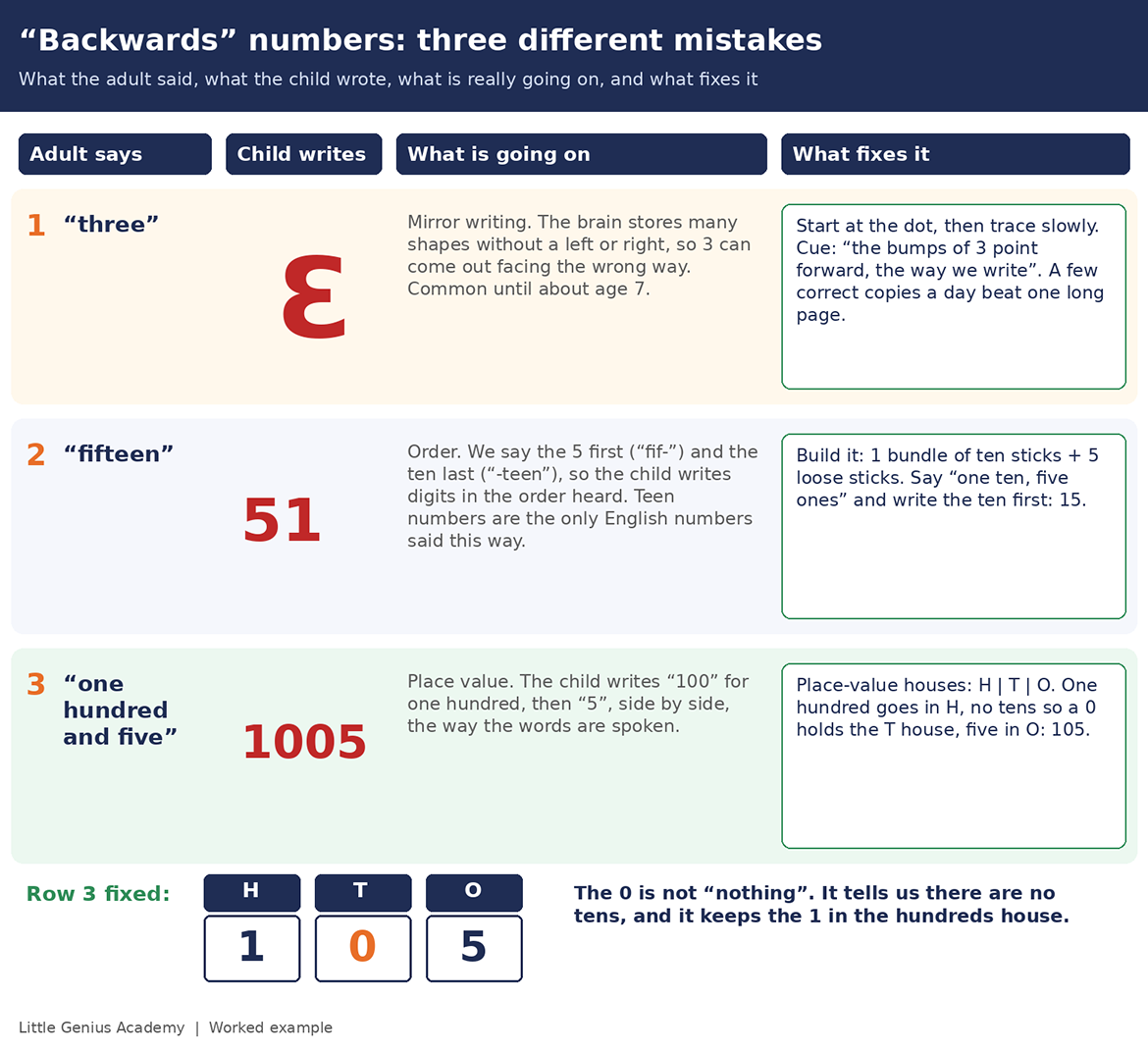
Worked example: three numbers dictated to a young child, what the child wrote, the real reason behind each mistake, and the fix. A mirrored 3 is a shape-memory issue, 51 for fifteen is a word-order issue, and 1005 for one hundred and five is a place value issue. The bottom strip shows 105 in hundreds, tens and ones houses.
Mistake 1: mirror writing numbers
This is the one most parents mean by backwards: a 3 that opens the wrong way, a 7 or a 9 that faces left, a 2 that looks like an S. Mirror writing numbers is common in children aged about four to seven, and it has a surprisingly clear explanation.
Our visual system evolved to recognise objects whichever way they face. A cup is a cup whether its handle points left or right, and a tiger is still dangerous if it turns around. Researchers call this mirror generalisation. Jean-Paul Fischer and Christophe Luxembourger, who have studied reversals in large samples of young children's writing, describe how a character's left or right orientation can be lost as it is stored in memory. The child remembers the shape of 3, but not which way it faces. Reading and writing are almost the only places in life where left and right suddenly matter.
Fischer's research on digit reversal also found a pattern in which digits get reversed. Children tend to write characters as if they face the direction of writing, to the right. Digits that naturally point left, such as 1, 2, 3, 7 and 9, are therefore reversed far more often than digits like 4, 5 and 6. If your child's reversals are mostly in that first group, they are following a very ordinary pattern.
What helps: a clear starting point (a dot where the pen begins), slow tracing with a finger and then a pencil, and a simple verbal cue, such as "the bumps of 3 point forward, the way we write". A few correct copies a day work better than a full page of repetitions, because a page of mirrored 3s practises the mistake.
Mistake 2: writing numbers in the wrong order (when a child writes 51 instead of 15)
This one is not about shape at all. It is about language. In English, every two-digit number above twenty is said in the same order it is written: "forty-two" is 4 then 2. The teens break that rule. In "fifteen" we say the 5 first ("fif-") and the ten last ("-teen"). A young child who writes down what they hear, in the order they hear it, writes 51. So when a child writes 51 instead of 15, they are often being perfectly logical.
Researchers have studied this in detail because some languages say every two-digit number units-first. German speakers say "two-and-forty" for 42, and research by Zuber and colleagues found that around half of the number-writing errors made by German first graders were these inversion errors. A 2021 study by Steiner and colleagues comparing German and English children found that inversion-related errors were much rarer in English overall, which fits the fact that in English only the teens are said backwards. That is exactly where English-speaking children slip.
Many Indian families have an extra layer. Children often learn number names in English at school and in Hindi, Gujarati, Tamil or another language at home, and two-digit number names in several Indian languages are irregular words that have to be learned one by one. Juggling two systems is a real cognitive load, and it is a good reason to make the structure of the number visible rather than relying on the spoken word alone.
What helps: build teen numbers with real objects. One bundle of ten sticks (or a full ten-frame) and five loose sticks. Say "one ten and five ones" before saying "fifteen", and always write the ten first. Writing numbers in the wrong order usually disappears quickly once a child can see that the 1 in 15 is a whole bundle of ten.
Mistake 3: place value mistakes (one hundred and five becomes 1005)
The third mistake also comes from writing what is heard, but with bigger numbers. A child hears "one hundred" and writes 100, then hears "and five" and writes 5 next to it. The result, 1005, is a faithful record of the words, and it shows the child has not yet understood that the position of a digit tells you its value.
A study by Lisa Byrge, Linda Smith and Kelly Mix, published in Child Development in 2014, asked 172 children aged four to six to write three-digit numbers they heard. Many of their errors had exactly this shape, for example writing "six hundred and forty-two" as 600402, with each spoken part written as its own chunk. The researchers saw these errors as an early stage of understanding place value rather than a failure: the children knew 600 and 42 belonged together, they just did not yet know how the places fit.
What helps: place value houses. Draw three boxes labelled H, T and O for hundreds, tens and ones. One hundred goes in the H house. There are no tens, so a 0 keeps the T house occupied. Five goes in the O house. The number is 105. The key idea for the child is that zero is not "nothing" here; it is holding a place. Expanded form, 100 + 0 + 5, and building the number with flats, rods and cubes make the same point in other ways. Most place value mistakes at this age come from this one missing idea.
How can I tell which mistake my child is making?
Try a two-minute dictation. Say six numbers aloud, one at a time, and ask your child to write them: 3, 7, 15, 17, 42 and 105. Then look at the page together, calmly.
- If single digits are mirrored but the order of digits is right, it is mistake 1.
- If 15 or 17 come out as 51 or 71, but 42 is correct, it is mistake 2.
- If 105 comes out as 1005 or 10005, it is mistake 3.
Many children show two of the three at once, which is fine. Each one has its own fix, and working on one does not get in the way of the others.
When should a parent look more closely?
Occasional reversals are normal up to about age seven or eight. It is worth talking to your child's teacher if mirror reversals are still frequent after that age and are showing up alongside real difficulty with reading or spelling, or if your child seems to struggle to see the board or track along a line. A simple eye check is a sensible first step in that case. For most children, though, reversals fade steadily with clear modelling and a little daily practice, and they need no label at all.
Are number reversals a sign of dyslexia?
Not on their own. Reversals are common in typically developing
children, and on their own they are not a reliable sign of a learning difficulty. The pattern over time, and what
else is happening with reading and spelling, matters far more than reversals alone.
Should I correct every reversed number?
Gently, and without making a big deal of it. Point to the correct
model, let your child trace it, and move on. Long correction sessions tend to make children anxious about writing
numbers at all.
Will my child grow out of writing 51 for fifteen?
Usually, yes, but it happens faster and more securely
when the child understands why 15 is written with the ten first. Building teen numbers with real objects is the
quickest route.
How we teach number writing and place value
In Math World, our concept-based maths programme for children aged 3 to 14, number writing and place value are taught at the Foundation levels with objects first, pictures second and symbols last, so a child builds fifteen as one ten and five ones long before they are asked to write it. Our teachers listen for the reason behind each mistake, because a mirrored 3 and a backwards 15 need completely different help, and every class is one-to-one, so that difference is caught early rather than practised for a term.
Related Posts

Teach Your Child to Make Rational Decisions
Read More


Importance of Communication
Read More
Teamwork for The Win?
Read More
Time Management
Read More
English At Home
Read More
Sustainable Leaders of The Coming Decade / Agents of Change
Read More
Importance of Developing Soft Skills
Read More
How to Make a Bumpy Transition Seamless
Read More
How to prepare for your child?s career
Read More
Sustainable Materialism
Read More
Benefits of Volunteering from An Early Age
Read More
Dynamic of a teacher and students in a modern-day classroom setting
Read More
The usefulness of art methods in reducing daily life stress for children?
Read More
Online safety for kids
Read More
Tips to make a child a better speaker/reader
Read More
How to Be a Working Parent
Read More
Raising Easily Distracted Children
Read More
Talking about puberty with children
Read More
Tips for Raising Kids in Multigenerational Households
Read More
Importance Of Logical Reasoning In The 21st Century
Read More
A Complete Guide To Developing Soft Skills
Read More
How to teach public speaking to your children
Read More
How do I make my child a better speaker
Read More
Importance of Skill Based Learning
Read More
Importance of Parents? Involvement in Early Childhood Education?
Read More
Strategies for tackling homework with kids
Read More
Kinesthetic Multiplication Activities for Kids
Read More
Outdoor Learning: Engaging energetic kids
Read More
Engaging Creative Writing Exercises for Young Minds
Read More
Top 10 Ways to Solve Comprehension Questions
Read More
How to Prepare for Spelling Bees
Read More
How to Develop Strong Comprehension Skills in Kids
Read More
The Discipline Flowchart for Kids
Read More
The Future of Learning: How AI is Transforming Education for Kids
Read More
Empowering Financial Minds Early?
Read More
Why Spelling Bees are Important for Your Child's Future
Read More
Mastering Basic Math Facts
Read More
Phonics That Work: Helping Your Child Read Confidently in 90 Days
Read More
Grammar Without Tears: How to Build English Fluency in Young Children
Read More
Creative Writing for Kids: Igniting the Spark of Imagination
Read More
How One-on-One English Classes Online Are Transforming Learning for Kids
Read More
Cracking the Code: How Strong Numeracy Skills Shape Future Success in Math and Beyond
Read More
Why Grammar Still Matters in the Age of Texts and Emojis
Read More
Building Confidence Through Public Speaking: The Little Genius Approach
Read More
Unlocking Confidence Through Communication: Why Public Speaking Should Start Young
Read More
5 Ways to Integrate Geography in Children's Learning Journey
Read More
Mastering Grammar: The Key to Confident Communication for Young Learners
Read More
Early Math Skills in Indore: Giving 3-Year-Olds a Head Start with Numbers
Read More
Early Math Learning in Udaipur: Helping 3-Year-Olds Build Confidence with Numbers
Read More
Building Early Reading Skills in Indore: Why Phonics Is the Key for 3-Year-Olds
Read More
Teaching Your Child to Work as a Team
Read More
Why Pure Phonics Works Better Than Synthetic Phonics for Indian Learners ? A Parent?s Guide from Jaipur
Read More
Best Phonics Class in Jodhpur: How Pure Phonics Builds Confident Readers
Read More
Best Phonics Class in Udaipur: Helping Children Read with Clarity and Confidence
Read More
Best Phonics Class in Kanpur: Helping Children Read with Confidence Through Pure Phonics Learning
Read More
Best Phonics Class in Patna: Helping Children Read with Clarity and Confidence Through Pure Phonics
Read More
Best Phonics Class in Jamnagar: Building Confident Readers Through Pure Phonics
Read More
Best Phonics Class in Hebbal: Building Strong Reading and Speaking Skills Through Pure Phonics
Read More
Best Phonics Class in Malleshwaram: Helping Children Build Strong Reading Skills Through Pure Phonics
Read More
Best Phonics Class in Electronic City: Helping Children Become Clear, Confident Readers Through Pure Phonics
Read More
Why Online Phonics Classes Are the Best Start for Early Readers (Ages 4–6)
Read More
How Online Phonics Classes Build Strong Reading and Speaking Skills in Children
Read More
Why Online Phonics Classes Are the Best Start for Early Readers (Ages 4–6)
Read More
Pure Phonics vs Memorisation: How Children Learn to Read Independently
Read More
Best Phonics Class in Raipur: Building Strong Readers Through Pure Phonics Teaching
Read More
Blending and Segmenting: The Skills That Turn Sounds Into Reading
Read More
Blending and Segmenting: The Skills That Turn Sounds Into Reading
Read More
Blending and Segmenting: The Skills That Turn Sounds Into Reading
Read More
Best Phonics Class in Nagpur: Helping Children Read with Confidence Through Pure Phonics
Read More
Pure Phonics vs Memorisation: How Children in Dubai Learn to Read Independently
Read More
Pure Phonics vs Memorisation: How Children Learn to Read Independently
Read More
What Is Phonics and Why It Is the Foundation of Reading for Young Children
Read More
What Is Phonics and Why It Is the Foundation of Reading for Young Children
Read More
Why Knowing the Alphabet Is Not Enough to Learn Reading
Read More
Why Knowing the Alphabet Is Not Enough to Learn Reading
Read More
Why Knowing the Alphabet Is Not Enough to Learn Reading
Read More
What Is Phonics and Why It Is the Foundation of Reading for Young Children
Read More
Blending and Segmenting: The Skills That Turn Sounds Into Reading
Read More
Why Knowing the Alphabet Is Not Enough to Learn Reading
Read More
Pure Phonics vs Memorisation: How Children in Abu Dhabi Learn to Read Independently
Read More
What Is Phonics and Why It Is the Foundation of Reading for Young Children
Read More
Blending and Segmenting: The Skills That Turn Sounds Into Reading
Read More
Why Knowing the Alphabet Is Not Enough to Learn Reading
Read More
Pure Phonics vs Memorisation: How Children in Sharjah Learn to Read Independently
Read More
What Is Phonics and Why It Is the Foundation of Reading for Young Children
Read More
Blending and Segmenting: The Skills That Turn Sounds Into Reading
Read More
Why Knowing the Alphabet Is Not Enough to Learn Reading
Read More
Pure Phonics vs Memorisation: How Children in Ajman Learn to Read Independently
Read More
What Is Phonics and Why It Is the Foundation of Reading for Young Children
Read More
Blending and Segmenting: The Skills That Turn Sounds Into Reading
Read More
Why Knowing the Alphabet Is Not Enough to Learn Reading
Read More
Pure Phonics vs Memorisation: How Children in Kuwait Learn to Read Independently
Read More
What Is Phonics and Why It Is the Foundation of Reading for Young Children
Read More
Blending and Segmenting: The Skills That Turn Sounds Into Reading
Read More
Why Knowing the Alphabet Is Not Enough to Learn Reading
Read More
Pure Phonics vs Memorisation: How Children in Bahrain Become Confident Readers (and When 1:1 Phonics Helps Most)
Read More
What Is Phonics and Why It Is the Foundation of Reading for Young Children
Read More
Blending and Segmenting: The Skills That Turn Sounds Into Reading
Read More
Why Knowing the Alphabet Is Not Enough for Reading
Read More
Pure Phonics vs Memorisation: How Children in Qatar Become Confident Readers (And When 1:1 Phonics Makes the Difference)
Read More
Blending and Segmenting: The Skills That Turn Sounds Into Reading
Read More
Why Knowing the Alphabet Is Not Enough to Learn Reading
Read More
Pure Phonics vs Memorisation: How Children in Bahrain Become Confident Readers (and When 1:1 Phonics Helps Most)
Read More
What Is Phonics and Why It Is the Foundation of Reading for Young Children
Read More
Blending and Segmenting: The Skills That Turn Sounds Into Reading
Read More
Why Knowing the Alphabet Is Not Enough for Reading
Read More
Pure Phonics vs Memorisation: How Children in Qatar Become Confident Readers (And When 1:1 Phonics Makes the Difference)
Read More
“My Child Knows ABC but Cannot Read” — A Guide for Al Khobar Parents
Read More
“My Child Knows ABC but Cannot Read” — A Guide for Dammam Parents
Read More
“My Child Knows ABC but Cannot Read” — A Guide for Riyadh Parents
Read More
Best Online Phonics Classes in Al Khobar: A Complete Guide for Parents
Read More
Best Online Phonics Classes in Dammam: A Complete Guide for Parents
Read More
Best Online Phonics Classes in Jeddah: A Complete Guide for Parents
Read More
Best Online Phonics Classes in Riyadh: A Complete Guide for Parents
Read More
Blending and Segmenting: The Skills That Turn Sounds Into Reading
Read More
One-on-One Phonics Classes for Kids in Al Khobar: When Personal Attention Makes the Difference
Read More
One-on-One Phonics Classes for Kids in Dammam: When Personal Attention Makes the Difference
Read More
One-on-One Phonics Classes for Kids in Jeddah: When Personal Attention Makes the Difference
Read More
One-on-One Phonics Classes for Kids in Jeddah: When Personal Attention Makes the Difference
Read More
“My Child Knows ABC but Cannot Read” — A Guide for Jeddah Parents
Read More
One-on-One Phonics Classes for Kids in Riyadh: When Personal Attention Makes the Difference
Read More
Online Phonics Classes vs Private Tutor in Al Khobar: What Should Parents Choose?
Read More
Online Phonics Classes vs Private Tutor in Dammam: What Should Parents Choose?
Read More
Online Phonics Classes vs Private Tutor in Jeddah: What Works Better for Your Child?
Read More
Online Phonics Classes vs Private Tutor in Riyadh: What Works Better for Your Child?
Read More
Pure Phonics vs Memorisation: How Children in Saudi Arabia Become Confident Readers (And When 1:1 Phonics Helps Most)
Read More
What Is Phonics and Why It Is the Foundation of Reading for Young Children
Read More
Why Knowing the Alphabet Is Not Enough for Reading
Read More
“My Child Knows ABC but Cannot Read” — Understanding the Real Problem
Read More
Best Online Phonics Classes in New Zealand: A Complete Guide for Parents
Read More
One-on-One Phonics Classes for Kids in New Zealand: When Individual Support Makes a Difference
Read More
Online Phonics Classes vs Private Tutor in New Zealand: What Should You Choose?
Read More
One-on-One Spoken English Classes for Kids Online: Why Personalized Attention Works Best
Read More
Concept-Based Math Classes for Kids Online: Why Understanding Beats Memorizing
Read More
One-on-One Online Phonics Classes for Kids in Sydney, Scheduled Around Your Family's Day
Read More
One-on-One Public Speaking Classes for Kids Online (Ages 3–10)
Read More
Why Does My Child Struggle With Word Problems, Even Though They're Fine With Straightforward Sums?
Read More
Best Online Phonics Classes for Kids in Melbourne, Scheduled Around Your Family's Day
Read More
Why Does My Child Know the Multiplication Tables But Still Calculate Slowly?
Read More
One-on-One Online Phonics Classes for Indian Kids in Auckland
Read More
Why Concept-Based Learning Is Better Than Rote Learning for Kids
Read More
Why Does My Child Get the Right Final Answer but Still Lose Marks for Method?
Read More
One-to-One Online Maths Classes for Indian Kids in Sydney
Read More
How to Improve Creative Writing Skills in Children
Read More
Why Does My Child Understand a Concept in Class But Forget It During Exams?
Read More
One-on-One English Grammar Classes for Kids in Sydney: Built Around How Children Actually Learn Grammar
Read More
How to Improve English Speaking Confidence in Children
Read More
Numeracy vs Mathematics: What's the Difference for Kids, Explained Simply
Read More
Best 1:1 Online Maths Tutor for Kids in Melbourne
Read More
How to Teach Grammar to Young Kids at Home
Read More
Blends vs Digraphs, Explained Simply
Read More
Online Maths Classes for NRI Kids in Auckland: A Complete Guide for Indian Parents in New Zealand
Read More
Why Is Spoken English Important for Young Children?
Read More
Why Does My Child Mix Up Is/Are/Was/Were?
Read More
One-on-One English Grammar Classes for Kids in Melbourne
Read More
Why Indian Parents in Australia Choose One-on-One Online Tutoring for Their Kids
Read More
Why Isn't My Child's Vocabulary Growing Even Though They Read a Lot?
Read More
Online Tuition for NRI Kids in Australia: Finding the Gap Before You Fix It
Read More
How to Help a Shy Child Speak Confidently
Read More
Phonic Sounds: What They Are and How to Teach Them at Home
Read More
Indian Curriculum Online Classes in New Zealand: English, Reading and Maths, One to One
Read More
Why Is General Knowledge Important for Kids?
Read More
Homophones vs Homonyms, Explained Simply
Read More
Online phonics classes for NRI kids in New Zealand
Read More
What Age Should a Child Start Public Speaking Classes? A Stage-by-Stage Guide for Parents
Read More
Why Does My Child's Writing Feel Flat or Boring? What Is Really Missing and How to Fix It
Read More
My Child Is Weak in Maths: What Should I Do? A Step-by-Step Answer for Parents
Read More
Why Does My Child Make Careless Mistakes in Maths When They Know the Method?
Read More
Online Phonics Classes for Kids in Australia: Getting Ready for What the Year 1 Phonics Check Really Tests
Read More
Paragraph on a Lion for Class 3: A Typical First Attempt, a Better Version and Four Tips
Read More
Extempore vs Prepared Speech, Explained Simply: Why Your Child Can Do One and Not the Other
Read More
Personalized Math Classes for NRI Kids: When the School Changes, the Concept Should Not
Read More
Story Writing for Class 4 with Examples: A First Attempt, a Better Version and a Five-Part Plan
Read More
Why Does My Child Still Count on Fingers? What It Means and the Four Steps to Mental Maths
Read More
Why Is My Child Still Sounding Out Words Letter by Letter Instead of Blending?
Read More
Early Learning in Nagpur: Using Phonics and Math to Build Strong Foundations for 3-Year-Olds
Read More